Report: Symposium "Religion(s) in an Age of Digitalization"
The symposium "Religion(s) in an Age of Digitalization" was organized during Professor Elisabeth Tveito Johnsen’s stay at the URPP and the Collegium Helveticum from September to mid‑December 2025 by her and with support from Thomas Schlag as Director of the URPP and colleague from Practical Theology. The symposium took place on 11–12 November 2025 at the Collegium Helveticum.
The event brought together media and communication scholars, theologians, sociologists, and scholars of religion to explore the implications of digitalization for religious institutions in the Nordic countries and Switzerland. Several URPP scholars contributed as presenters and respondents. The Scandinavian participants—Associate Professor Henrik Reintoft Christensen (Aarhus University), Associate Professor Stefan Gelfgren (Umeå University), and Associate Professor Frida Mannerfelt (Lund University)—were invited as special guests. One of the central themes was how digitalization relates to, and differs from, other major societal transformation processes such as mediatization and marketization. The programme featured presentations, panels, and discussions, and fostered lively exchange across the two contexts.
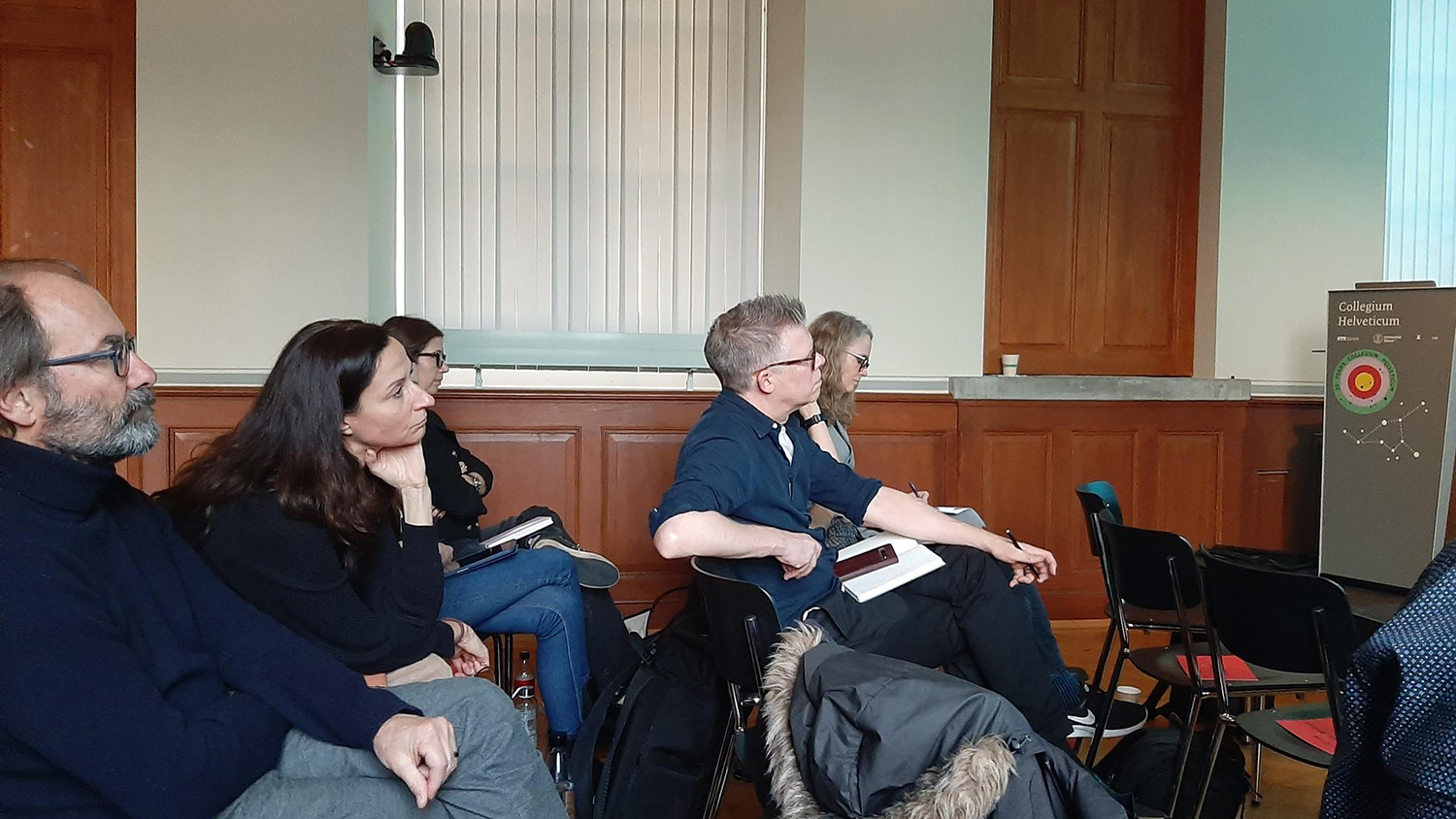
The symposium began with welcoming words from Sebastian Bonhoeffer, director of the Collegium Helveticum followed by opening addresses by Director of the URPP, Professor Thomas Schlag, and Elisabeth Tveito Johnsen. Schlag provided an outline of the URPP, and particularly the research in the second phase of the program. Referring to "the four waves of digital religion", he emphasized that these are not to be understood as linear phases, but rather dynamic and interwoven processes of transformation. Having led the URPP as a highly interdisciplinary program from its first to its second phase, he encouraged multi-perspective approaches to digital religion. Johnsen argued in her address that the actor-network-theory (ANT), as it is developed by Latour, has the potential to expand the analysis of digital religion in religious communities. She particularly highlighted that ANT focuses on non-human actors, which is different from both the actor-oriented theories, as developed by Campbell, and mediatization theory, as developed by Lundby, Hjarvard, Hepp and Couldry.
The first panel, "Preaching the Words of AI," comprised two talks. Professor Sabrina Müller (URPP/Bonn) presented research on how ministers employ AI when composing sermons. Her study found that the studied ministers adopt an ethos of experimentation and openness: AI is regarded as a partner rather than a threat. Mannerfelt’s study showed that pastors in the Church of Sweden tend to both overestimate AI’s contextual knowledge and underestimate its theological capacities. Mannerfelt asked whether there is a need for AI literacy within the clergy and argued that theological reasoning remains necessary even after AI is introduced into homiletic practice.

The second panel, "Feeling Rules, Emotional Labor, and Community in a Digital Age," opened with Co‑PI and postdoctoral researcher Mira Menzfeld (URPP). Her research asks whether the Madkhali Salafis can align with manosphere followers, exemplified by Andrew Tate, and shows that one of the main barriers to such alignment is that these groups are constituted by different models of emotional regulation, creating an unbridgeable divide. Whereas the principal feeling rule within Salafism is "What would God want me to feel?", manosphere followers are oriented towards emotional peer‑to‑peer validation. Thus, even if some ideals appear shared, the two groups inhabit fundamentally different affective worlds. The second speaker was Associate Professor Henrik Reintoft Christensen (Aarhus University). His talk presented research on how Christian, Islamic, and Buddhist communities engaged with digital religion during and after the pandemic. Meeting physically was among the aspects informants missed most during the pandemic. Most informants stated that digital religion is inadequate because it does not allow them to feel the presence of others. The third panelist, Johnsen, presented research on how digital communication practices used to promote drop‑in weddings on Valentine’s Day transform the Church of Norway’s production of meaning concerning church weddings and marriage. She finds that digital media facilitate a more privatized understanding of marriage and more standardized wedding ceremonies, and attribute new emotional meaning to the church as wedding planner and provider, largely replacing the family.

The theme of the second day of the symposium was "Looking into the Future of Religions in a Digital Era." The first panel, "Religion in a Digitalized Society," comprised three presentations. The opening presentation by Professor Mark Eisenegger and postdoc/Co‑PI Rebekka Rieser examined how churches in Switzerland are perceived in terms of reputation. Their principal finding was that personal experiences and traditional media have a stronger impact than digital media. The touchpoints that matter most for the population at large are related to illness, difficult moments in life, and life events; these may therefore represent some of the most important digital touchpoints for churches in the future. In the second talk, Johnsen and Schlag examined how church workers in Norway and Switzerland engage with digital media. Their study indicates that mediatization is an unpredictable process, that the participatory nature of social media is a moving target, and that innovative understandings of Christian community can emerge both through strategic outreach and through episodic expansion. The third speaker, Associate Professor Stefan Gelfgren, addressed whether digital religion research exhibits a normative bias that privileges transformative approaches. Based on studies of technology‑reluctant movements — the Laestadian movement and the Finnish Orthodox Church — he argued that future research should pay greater attention to how a mediatized society shapes non‑use of digital media.

The symposium was concluded by a roundtable under the title "Religions in the future – How will Digitalization change religion on a long-term basis?". Christensen, Mannerfelt, Müller and Eisenegger were asked to provide their views on three questions:
- Insights: "What inspired, surprised, irritated you most from the presentations?"
- Open question: "What do you want to continue with in your work – also in an interdisciplinary sense?"
- Perspectives: "How do you take on the perspective of responsibility in your work in the field?"
One of the main outcomes of this panel was that in times of digitalization and due to the complexity of its dynamics (like "hybridization" and "eventification") and also due to current secularization processes, contextual approaches to the diverse phenomena is strongly required, e.g. including other forms of "Christiany" beyond the institutional forms of Church practice, but also the practices of the so called "non-religious".
In the end, Johnsen wrapped up the symposium by underscoring the high value and inspirational quality of interdisciplinary conversations. The symposium may have long‑lasting effects on our research in terms of contacts, collaboration, and mutual reading of each other’s work. She emphasized that studying digital religion involves investigating a moving target: developments in technology are rapid, and the ways in which religious communities engage with digital media are far from straightforward. She also noted that critical discussions concerning the normative assumptions embedded in research on digital religion have stimulated further reflection. The symposium demonstrated that continued exchange between digital religion researchers in Scandinavia and Switzerland is needed.

As organizers, we thank all presenters for their insightful contributions. We are grateful to Fabienne Greuter for chairing several sessions, and to the respondents Stefan Gelfgren, Jan Segessenmann, Ulvi Doguoglu, and Jan Danko, who provided responses without having read the presentations in advance. Administrative assistance from Jamie Bisang, Collegium Helveticum, ensured that the event ran smoothly.